To Compress or Not? Pushing the Frontier of Lossless GenAI Model Weights Compression with Exponent Concentration

Zeyu Yang, Tianyi Zhang, Jianwen Xie, Chuan Li, Zhaozhuo Xu, Anshumali Shrivastava
Accepted at the International Conference on Learning Representations (ICLR), 2026
Disclosure: this post describes my own work, so treat the framing as that of an author rather than a neutral third party.
Modern GenAI models are enormous. DeepSeek-R1 alone has 671 billion parameters. Even after converting to FP8, serving these models eats up massive amounts of GPU memory and bandwidth. The standard response is lossy quantization: throw away some precision and hope the outputs don't degrade too much. But what if you didn't have to lose anything at all?
In this work, we show that you can losslessly compress FP8 model weights by exploiting a simple observation about how neural networks store information. The result is ECF8, a format that saves up to 26.9% memory and speeds up inference by up to 177.1%, while producing outputs that are bit for bit identical to the original model.
A Curious Pattern in the Bits
The starting point of this work is an empirical finding that surprised us. When we looked at the exponent bits of FP8 model weights across a wide range of architectures (LLMs, diffusion transformers, vision models), we found that these exponents are remarkably concentrated. Out of the 4 exponent bits in FP8, the Shannon entropy is typically only around 2 to 3 bits per layer. In other words, most of the exponent values are redundant.
Here's what this looks like across 9 different models. LLMs are on the top two rows, diffusion transformers on the bottom:
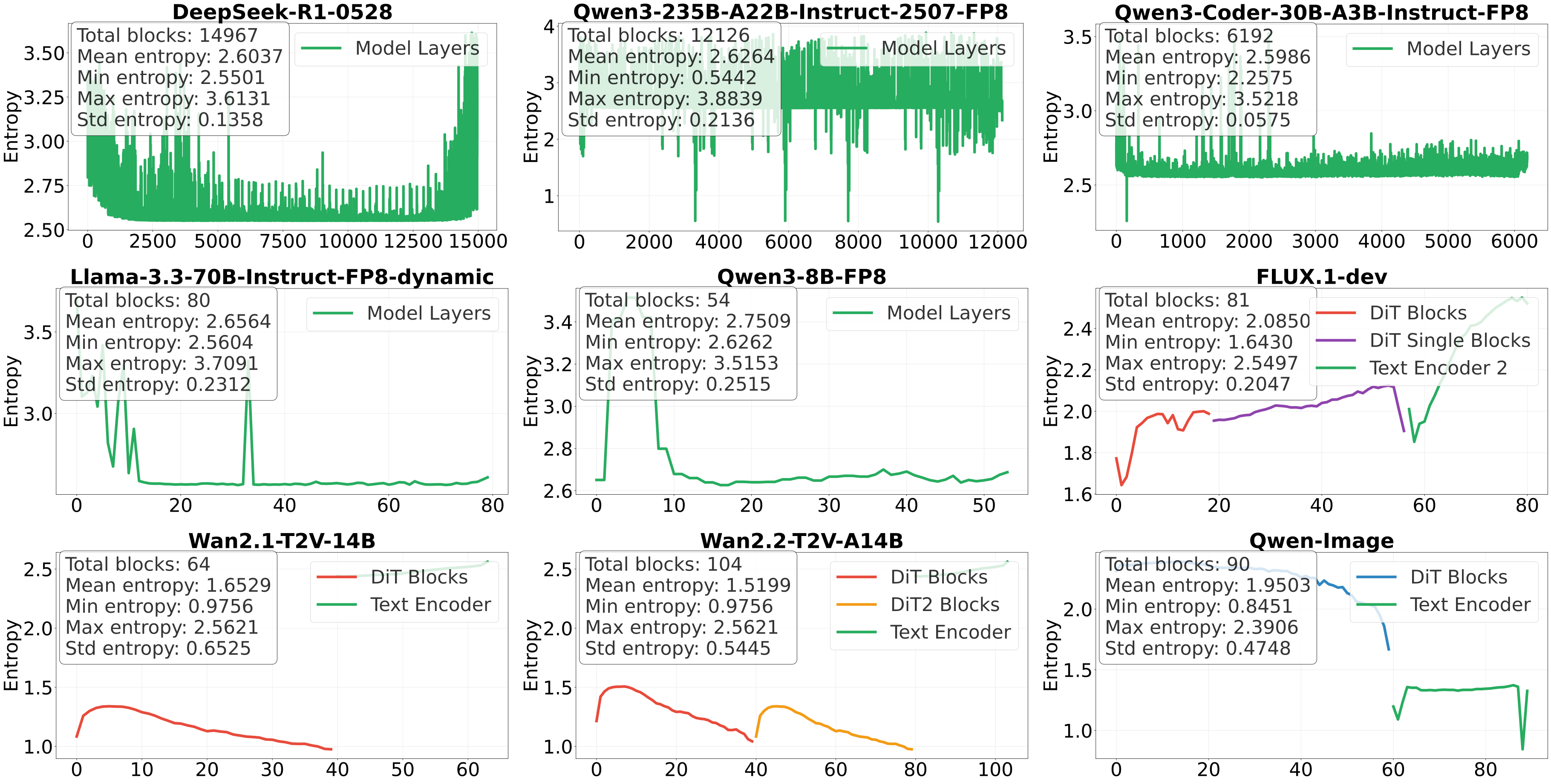
The pattern is strikingly consistent: no matter the architecture, the model size, or the modality, exponent entropy stays low. We call this exponent concentration.
Why Does This Happen?
This isn't just an empirical curiosity. There's a solid explanation for it. The weights of neural networks trained with SGD are known to follow heavy tailed, -stable distributions (Simsekli et al., 2019; Gurbuzbalaban et al., 2021). We prove that when weights come from such distributions, the entropy of the exponent field is tightly bounded. In our analysis, the Gaussian case () yields exponent-entropy bounds that fall between approximately 1.6 and 2.67 bits.
This analysis also gives us a theoretical compression floor: the minimum number of bits needed for a full floating point representation works out to roughly FP4.67. In other words, there's still significant room beyond FP8 for lossless compression, and exponent concentration is the key to unlocking it.
How ECF8 Works
The idea behind ECF8 is straightforward. If the exponent bits have low entropy, encode them with fewer bits using Huffman coding and leave the rest untouched.
In practice, making this work efficiently on GPUs is the hard part. Our pipeline has three main components:
-
Entropy aware encoding: We build Huffman codes from the empirical exponent distribution of each layer, with a maximum code length of 16 bits for GPU compatibility.
-
Hierarchical lookup tables: For fast decoding, we use cascaded 256 entry subtables that can be traversed in parallel:
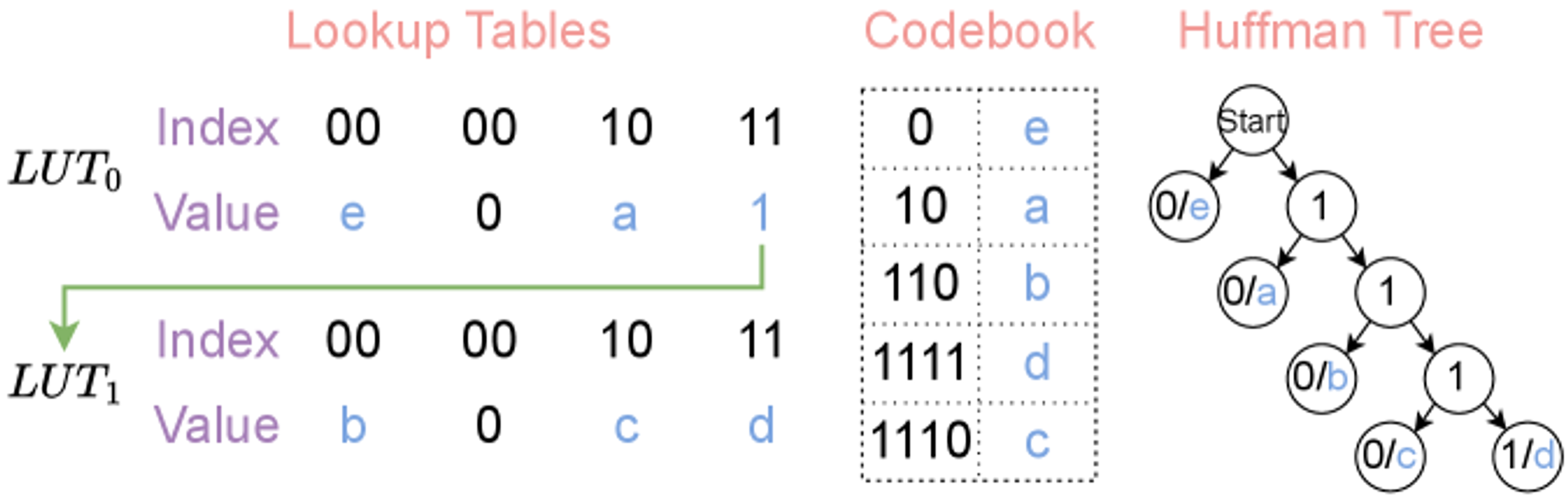
- GPU optimized decoding kernel: A five phase pipeline (memory init, data load, parallel counting, coordinated decode, global writeback) using 64 bit sliding windows and shared memory. Decompression happens just in time with a single preallocated buffer.
Results
We tested ECF8 across 9 models spanning LLMs and diffusion transformers, up to 671B parameters. Here's what we found.
Weight Compression and Throughput
| Model | Params | Memory Reduction | Throughput Gain |
|---|---|---|---|
| DeepSeek-R1-0528 | 671B | 14.8% | 150.3% |
| Qwen3-235B-A22B | 235B | 14.4% | 35.9% |
| Llama-3.3-70B | 70B | 13.4% | 11.3% |
| Qwen3-Coder-30B | 30.5B | 14.3% | 23.7% |
| Qwen3-8B | 8B | 9.8% | 12.6% |
| FLUX.1-dev | 16B | 14.1% | 177.1% |
| Wan2.1-T2V-14B | 14B | 25.4% | 55.1% |
| Wan2.2-T2V-A14B | 30B | 26.9% | 108.3% |
| Qwen-Image | 20B | 21.0% | 126.6% |
The diffusion models benefit the most because their exponent distributions are even more concentrated, enabling higher compression ratios. FLUX.1-dev sees a nearly 3x throughput improvement at the weight level. Note that this figure is a weight-level microbenchmark, not a full-pipeline number; the end-to-end speedups (reported in the diffusion table below) are smaller because they also include compute that ECF8 does not touch.
LLM Inference: Latency and Batch Size
| Model | Latency Reduction | Max Batch Size |
|---|---|---|
| DeepSeek-R1-0528 | 60.1% | 2 → 16 |
| Qwen3-235B-A22B | 26.4% | 32 → 64 |
| Llama-3.3-70B | 10.2% | 32 → 48 |
| Qwen3-Coder-30B | 19.2% | 16 → 32 |
| Qwen3-8B | 11.2% | 16 → 24 |
On DeepSeek-R1, ECF8 cuts per request latency by 60% and increases the maximum batch size from 2 to 16, an 8x improvement. This is because the bottleneck for large models is memory bandwidth, and ECF8 directly reduces the amount of data that needs to move.
Diffusion Models: End to End Speedup
| Model | E2E Latency Reduction | Memory Savings |
|---|---|---|
| FLUX.1-dev | 45.9% | 12.1% |
| Wan2.1-T2V-14B | 3.3% | 7.6% |
| Wan2.2-T2V-A14B | 4.0% | 17.8% |
| Qwen-Image | 55.9% | 7.9% |
Qwen-Image sees a 55.9% end to end speedup, and every generated image is pixel identical to the uncompressed model's output.
It's Actually Lossless
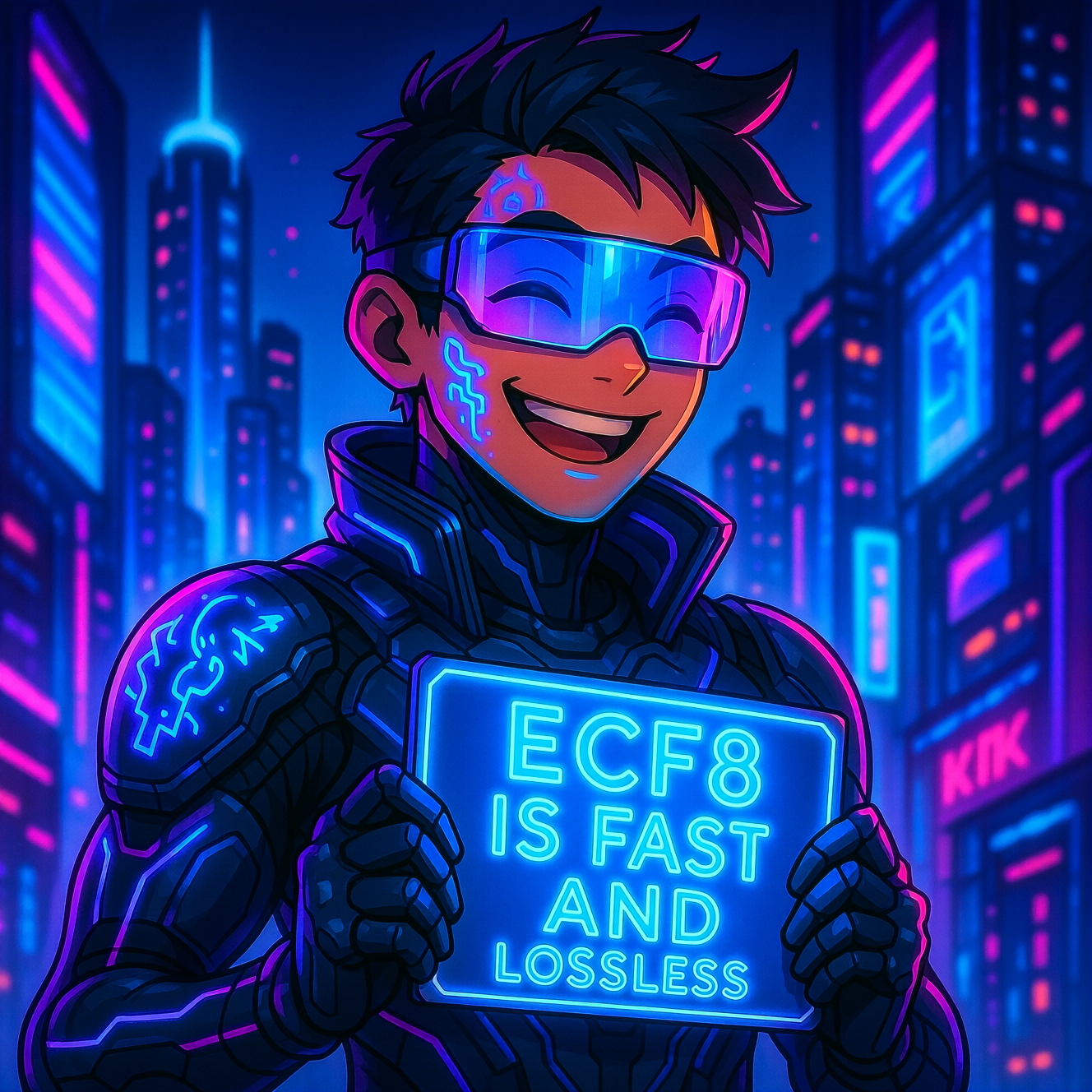
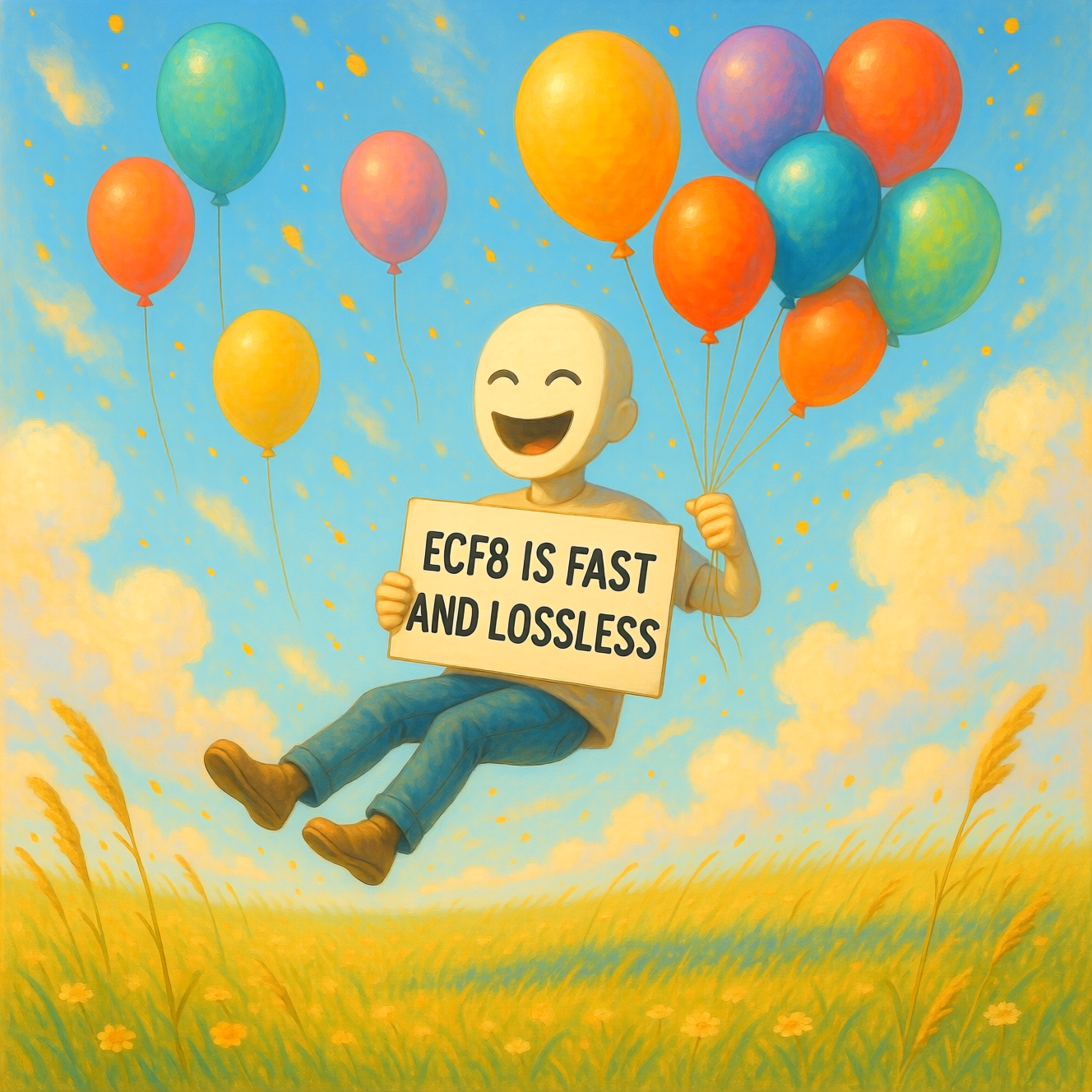
This is worth emphasizing: ECF8 is not "approximately lossless" or "nearly lossless." The outputs are bit for bit identical. Here are images generated by the ECF8 compressed Qwen-Image model. They match the original FP8 model down to every pixel:
 |  |
 |  |
How This Compares to Other Approaches
Compared to lossy quantization (GPTQ, AWQ, SqueezeLLM): These methods trade output quality for compression. ECF8 gives you compression with no calibration data, no quality loss, and no retraining, so you can use it as a direct replacement. The one cost is on-the-fly decompression, which adds a small overhead per weight access. As with the closely related DFloat11 (Zhang et al., 2025), this means net throughput gains depend on operating in the memory-bandwidth-bound regime (large models or large batch sizes), where the saved bandwidth outweighs the decode cost. This is consistent with our own observation that the bottleneck for large models is memory bandwidth.
Compared to DFloat11: DFloat11 (Zhang et al., 2025) targets BF16 weights and achieves ~30% compression by Huffman coding the low-entropy exponent field, also motivated by its Shannon entropy. ECF8 shares closely related encoding and decoding machinery (Huffman codes on exponent bits, hierarchical GPU lookup tables, and a GPU decode kernel), so the pipelines are similar by design. Our contribution is scoped to two things: (a) targeting the increasingly standard FP8 format, and (b) a theoretical framework, built on the -stable weight distribution, that bounds exponent entropy and gives a compression floor, explaining why this compression is possible rather than leaving it as an empirical observation alone.
Takeaway
The weights of trained neural networks have a hidden structure in their exponent bits, one that's universal across architectures and modalities, and that emerges naturally from the dynamics of SGD. ECF8 exploits this structure to compress FP8 weights losslessly, delivering real speedups on real models, with zero compromise on output quality.
If you're serving large models and care about exact reproducibility, give ECF8 a try.
References
- Mert Gurbuzbalaban, Umut Simsekli, Lingjiong Zhu (2021). The Heavy-Tail Phenomenon in SGD. Proceedings of the 38th International Conference on Machine Learning (ICML), PMLR v139. ↗
- Umut Simsekli, Levent Sagun, Mert Gurbuzbalaban (2019). A Tail-Index Analysis of Stochastic Gradient Noise in Deep Neural Networks. Proceedings of the 36th International Conference on Machine Learning (ICML), PMLR v97. ↗
- Tianyi Zhang, Mohsen Hariri, Shaochen Zhong, Vipin Chaudhary, Yang Sui, Xia Hu, Anshumali Shrivastava (2025). 70% Size, 100% Accuracy: Lossless LLM Compression for Efficient GPU Inference via Dynamic-Length Float (DFloat11). NeurIPS. ↗